


Seat Wars –

Yet Another Owner / Operators Update on Aircraft Seats – Prepare to Have Your Expectations Reclined.


There was a time — and it wasn't even that long ago — when a "premium" airplane seat meant a little extra padding and a tray table that didn't wobble. Those days are as gone as the ashtray in the armrest. Somewhere between the last decade and this one, the aircraft seat quietly staged a coup. It stopped being furniture and started being infrastructure — part bed, part office, part cocoon, part quiet flex on behalf of
whoever's paying for the jet fuel.
But "VIP seat" turns out to mean two rather different things depending on which side of the certification paperwork you're standing on. There's the chair a private jet owner commissions like a piece of furniture — one-of-one, fitted to their exact frame and taste. And there's the seat an airline buys by the hundreds, engineered to make a stranger in 2A feel like the only person on the airplane for fourteen hours. Both chase the same feeling, in different ways. So here it is in parts — bespoke private jet chairs, mass-produced commercial seats, and the outliers gunning to disrupt both.

PART ONE: Private Jet VIP Chairs
This is the world of the true one-off — a chair specified the way a suit is, nothing off the rack. Nobody here optimizes for cycles or turnaround time between passengers. They optimize for one owner, one mission, and a finish standard closer to yacht fit-out than anything resembling a commercial cabin.
Collins Aerospace: The Quiet Physics of Floating Furniture
_________________________________________
Collins Aerospace's Executive & VIP Seating division treats the private jet chair as a genuine engineering puzzle, not just a foam buildup / upholstery exercise. Its signature move is "mini-base" seating — a patented, track-mounted pedestal that shrinks the traditional seat base by roughly 50%, so the chair appears to hover within the cabin rather than a big box bolted to the floor. It's a small trick with an outsized visual payoff: more usable floor space, cleaner sightlines, and a cabin that reads less "airplane" and more "very expensive living room." Collins backs this with a full range of single and double executive seating plus VIP divans, certified across the 9G, 16G, and 21G structural categories that different aircraft platforms demand, and it recently doubled the production floor at its Medley, Florida facility to keep pace with demand — never a bad sign for an industry segment.
For owners who want privacy beyond even a very good chair, Collins' Elite and Serenity suite platforms bring enclosed, door-equipped compartments into the VIP cabin conversation — full separation on demand, open concept when you'd rather not feel cloistered. On the drawing board: continued investment in that Florida facility suggests Collins is betting the demand for genuinely private, structurally serious VIP seating keeps climbing, not leveling off.


Iacobucci HF Aerospace: Italian Design House Energy
_________________________________________
If Collins brings aerospace engineering discipline, Iacobucci HF Aerospace brings something closer to automotive design pedigree. The Italian manufacturer's VIP Seat Division — built in partnership with Designworks USA, BMW Group's design studio — treats the private jet chair the way a concept-car interior gets treated: as a statement piece as much as a functional object. The pairing makes sense on paper and even more sense in person; this is a company that has spent years collaborating with names like Pininfarina on cabin seating, chasing the kind of sculpted, hand-finished silhouette that automotive designers obsess over and aviation engineers don't always get to.
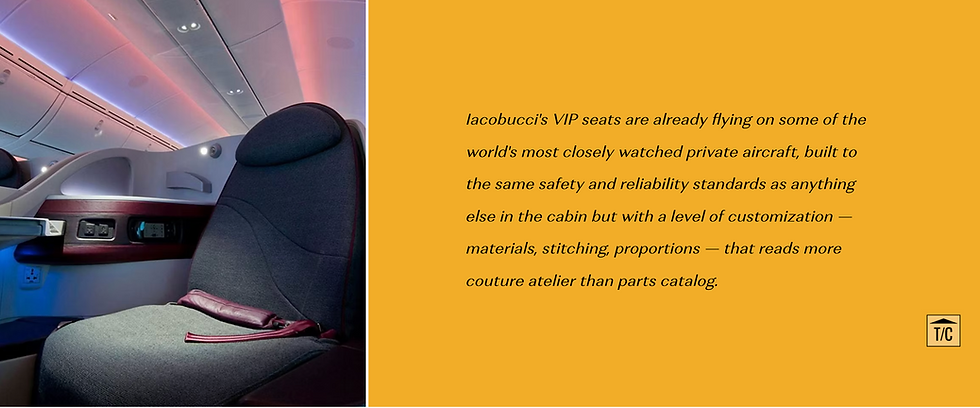
Iacobucci's VIP seats are already flying on some of the world's most closely watched private aircraft, built to the same safety and reliability standards as anything else in the cabin but with a level of customization — materials, stitching, proportions — that reads more couture atelier than parts catalog. The company was acquired by Japan's Jamco Corporation in late 2025 but continues operating independently under its existing leadership, which should mean more resources behind the same design-forward instincts rather than a change in direction. Worth watching for what the BMW Designworks partnership produces next — automotive design language has a habit of eventually reshaping how an entire category thinks about form.

Greenpoint Technologies (a Safran Cabin company): Head-of-State Standard
_________________________________________
Greenpoint doesn't so much sell chairs as sell entire private ecosystems of rest and work, and it operates at a level of confidentiality that makes most VIP completions shops look positively chatty. As the completions house behind some of the world's most closely guarded Boeing Business Jet 787-9 interiors, Greenpoint's AeroSuite — winner of the Cabin Design Award at the 2026 International Yacht & Aviation Awards — fuses a genuine lie-flat bed with a separate reclining lounge seat inside one fully enclosed suite, plus a sliding table, full-height wardrobe, and an oversized monitor for the passenger who insists on scrolling market data at 41,000 feet.
What's next for Greenpoint is, characteristically, need-to-know. The company has more VVIP BBJ 787-9 completions underway for confidential clients, continuing its quiet dominance of the head-of-state and ultra-high-net-worth segment. If history is any guide, whatever rolls out of Greenpoint's hangars next won't be photographed for a press release — it'll be photographed for a security briefing.

The Airframers Themselves: Gulfstream, Bombardier, and Dassault
______________________________________________________________________________________
Increasingly, the largest private jet manufacturers aren't outsourcing the chair at all — they're engineering it in-house, as inseparable from the airframe as the wing. Gulfstream's G700 arrives with handcrafted seats that articulate and berth into genuine beds, part of a cabin architecture configurable into up to five distinct living areas. Bombardier's newly certified Global 8000 leans on its signature Nuage seat — still one of the segment's most talked-about pieces of industrial design for its cantilevered, tilt-link recline — spread across four cabin zones for up to 19 passengers.
Then there's Dassault, which used its all-new Falcon 12X to make a genuinely audacious claim: Zero-G Recliner Seats with biometric sensors that actively adjust passenger posture to reduce pressure and fatigue on long legs. Paired with a cabin nearly ten feet wide — Dassault's widest ever — configurable into a master suite, dining area, media lounge, and private office, the 12X reads less like an airplane and more like a well-appointed apartment that happens to cruise at 51,000 feet. Deliveries begin late this year, with production slots sold out through 2028 — a reminder that in this segment, "waitlist" is itself a status symbol.
What's notable about all three programs is how deliberately they blur "seat" into "room." These airframers aren't simply commissioning better chairs from a catalog anymore — they're designing entire zones of the aircraft around how a passenger's body and schedule change over a long sector, then building seat, lighting, and cabinetry as one coordinated system.
The Completions Houses: Where the Chair Meets the Clieent
___________________________________________________________________________________________________
None of this matters without somewhere to build it, and 2026 has been a banner year for the completions centers that turn green airframes into finished VIP cabins — and it's these shops, working hand-in-hand with the chair manufacturers, that actually fit each seat to its one owner. AMAC Aerospace in Basel reports hangars running consistently full, with growing interest in widebody projects on the Airbus ACJ350 and Boeing BBJ777X platforms. Comlux has been expanding its Indianapolis operations and workforce at a striking clip — up 20% in 2025, with another 20% planned this year — partly on the strength of completing the ACJ TwoTwenty for Airbus Corporate Jets. And Jet Aviation brings roughly 200 skilled artisans in Basel to the business of hand-crafting bespoke cabin furniture, chairs included, at a level of joinery closer to a Swiss watch atelier than a factory floor.


What's on the Drawing Board for Private Jet Chairs
_______________________________________________________________________________________
A few clear throughlines emerge for where VIP seating is headed next. Hyper-personalization keeps climbing — bespoke materials, client branding, and one-off proportions are moving from "nice request" to "starting expectation." Wellness-driven ergonomics are showing up as a real design category rather than a gimmick, with massage functions and posture-sensing recline appearing on flagship programs like the Falcon 12X. And modularity is having a moment: chairs and divans that convert cleanly between conference, club, and flat-bed configurations let one cabin genuinely serve three different missions in a single day, without the owner having to choose which version of "VIP" they want permanently bolted to the floor.

This is a different discipline entirely — every pound matters, every seat has to survive thousands of strangers and a maintenance schedule, and "bespoke" has to somehow be manufactured at scale. And 2026 is shaping up to be a genuine watershed year for the category, with privacy, technology, and outright suite-level luxury increasingly treated as the baseline rather than the upsell.
Collins Aerospace: The Suite Life, at Scale
_______________________________________________________________________________________
On the commercial side, Collins has spent the last few seasons proving that "seat" is a generous understatement for what it builds for airlines too. Its April 2026 unveiling with Air Canada — fourteen custom Aurora suites finished in wood, stone, and bronze accents, arriving on the carrier's new A321XLR alongside 168 Meridian+ economy seats — is a reminder that Collins doesn't just engineer comfort for commercial cabins, it art-directs it, working with design partners the way a couture house works with a tailor. Developed with Air Canada and design partner Acumen, Aurora leans hard into materials usually reserved for the private jet world, on an aircraft flown by paying strangers rather than a single owner.
On the drawing board, Collins showed off "Skynook" at the 2026 Aircraft Interiors Expo — a clever bit of lateral thinking that uses the natural taper of a fuselage to carve out a private sanctuary from otherwise wasted space near the window, aimed squarely at economy class. It's been shortlisted as a finalist for the Crystal Cabin Award, and it's a useful signal of where the whole category is heading: privacy features that used to be exclusive to the front of the aircraft are being re-engineered to work in the back of it too.
Recaro Aircraft Seating: Teaching Seats to Listen
____________________________________________________________________________________________________
Recaro has traditionally been the pragmatist of the commercial group — the company that made its name on weight savings and reliability rather than velvet-rope glamour. That reputation is getting a serious update. At AIX 2026, Recaro debuted the R7, a long-haul business platform roughly 20% lighter than comparable seats on the market, with electrical privacy dividers and full suite doors available for airlines that want the enclosure without the enclosure's usual weight penalty.
But it's the R7 Horizon demonstrator that had people doing double-takes. This concept seat introduces AI-powered voice control — passengers can reposition the seat with natural-language commands in more than 90 languages — alongside "Lumina Sync," a lighting system that adjusts to the passenger's circadian rhythm. In other words, your seat may soon know it's 3 a.m. body-clock time before you do, and start dimming accordingly. Recaro capped its year with double-digit revenue growth and a Crystal Cabin Award for its sustainable R Sphere seat, suggesting the company has figured out how to be both the responsible one and the interesting one at the same party.
Unum: The Minimalist With a Mechanism
_______________________________________________________________________________________
Unum has built its identity around doing more with less — literally. Its Unum One platform, built around a patented "Scimitar" mechanism, delivers genuine zero-gravity recline and a proper lie-flat bed from a seat that's notably lighter and more modular than its rivals, which matters enormously to airlines watching fuel burn as closely as they watch cabin aesthetics. 2026 marked the company's first certified A330 deliveries, with Wamos Air as launch customer, and 787 certification following close behind, alongside a continued push into single-aisle applications.
Where Unum goes next looks less like a single flashy reveal and more like patient, methodical platform expansion — new aircraft types, easier maintainability, and a continued bet that sustainability and luxury aren't actually in tension, whatever the industry's old guard used to assume.

The Airlines Are Doing Their Part Too
_______________________________________________________________________________________
None of this seat engineering happens in a vacuum — airlines are commissioning genuinely dramatic cabins to go with it, and 2026 has produced an unusually strong crop. United's redesigned Polaris cabin is landing on Boeing 787-9s with sliding privacy doors for every business seat and a front-row "Polaris Studio" option with companion seating, alongside Starlink connectivity. Air Canada's Signature Class suites, riding on Collins' Aurora hardware, bring fourteen 1-1 private suites to the new A321XLR. ANA's Room FX offers a 76.5-inch bed with wireless charging, rolling out fleet-wide starting in August. And Cathay Pacific's incoming Aria Studio suites replace older seating with 1-2-1 lie-flat configurations and direct aisle access for every passenger. Suites with doors, once the province of first class on a handful of flagship carriers, are fast becoming standard business-class equipment industry-wide.

Alongside the household names above, a smaller cast of startups and joint-venture skunkworks is sketching out ideas the big suppliers haven't gotten around to — or haven't dared. None have Gulfstream's balance sheet. All are betting the next real shift in how we sit won't come from the usual suspects.
The most talked-about outlier of the year is Chaise Longue, a Spanish startup born as a college project when its founder, Alejandro Núñez Vicente — a 6'2" designer perpetually folded into economy seats — sketched a simple fix: stack the seats. His double-level "Elevated Class" concept removes the overhead bin to fit two staggered rows, letting lower-tier passengers stretch their legs into the space beneath the seat in front — borrowing the legroom trick from staggered business class and handing it to economy. It sounds slightly absurd until you notice Airbus is quietly exploring early-stage concepts based on it, and until you realize it was a finalist in the Crystal Cabin Award's brand-new Breakthrough Start-ups category — proof the industry's biggest stage now has room for the kid with the sketchbook.
RAVE Aerospace paired with seating giant Safran on "Origin," a concept suite that treats the seat as a life-support system: air-bladder cushions that continuously redistribute pressure, a microclimate that actively heats or cools around the passenger, and a U-shaped immersive micro-LED display that shifts the suite's entire visual mood on command. It's less a seat than a convincing argument that the seat and the screen should never have been designed by separate departments.

ELSEWHERE, the disruption is aimed squarely at Economy.
_______________________________________________________________________________________
Zephyr Aerospace, a scrappy US startup, has spent several years refining a stacked lie-flat bed for premium economy that needs no motors at all — just a clever composite structure letting passengers lie fully flat in a 2-4-2 layout, no extra cabin real estate required.
Thompson Aero Seating took the opposite tack with its VantageNOVA First, a shapeshifting single seat that reconfigures into a double or four-across dining table on demand — handy for colleagues who'd rather share a meal at 40,000 feet than eat alone behind a privacy screen. ZIM Aircraft Seating's entry, The Frame, swaps synthetic structure for modular, repairable laminated wood, trimming weight and carbon footprint while making the seat easier to refurbish than replace. And Molon Labe Seating keeps pushing staggered seating designed around genuine wheelchair accessibility, arguing — correctly — that "innovative" should include the passengers the rest of the industry still treats as an afterthought.
Not every outlier is chasing comfort, either. Aviointeriors' Skyrider 2.0 leans the opposite way — a saddle-style perch designed to squeeze roughly 20% more seats onto an aircraft. Whether it ever flies commercially is beside the point; it's a reminder that "the conceptual edge" cuts both directions, and not every seat at this table is trying to make you more comfortable.

A Word on What's Under the Upholstery
_______________________________________________________________________________________
Underneath the headline features on all three fronts, there's a less glamorous throughline doing just as much work: what these seats are actually made of. Every gram saved is a gram of fuel not burned, whether the aircraft carries one owner or three hundred fare-paying passengers. Carbon-fiber substructures, 3D-printed brackets, and recycled or bio-based upholstery have quietly migrated from "interesting concept" to "standard spec sheet line item." Featherweight or opulent, rarely both, used to be the trade-off. Increasingly, it isn't one at all.
Landing the Plane
_______________________________________________________________________________________
If there's a single thread running through both halves of this story, it's that the seat has quietly become the industry's most honest storyteller, regardless of who's sitting in it or who's paying for it. The private jet owner and the business-class passenger are, in their own very different ways, being sold the exact same promise: a chair that anticipates you instead of merely accommodating you. One is built once, for one person, by hand, in Basel or Grand Prairie or Savannah. The other is built by the hundreds, tested to exhaustion, and still has to feel like it was built just for you between takeoff and the first beverage service. Pulling that off at either end of the spectrum is a genuinely hard engineering problem — and 2026 suggests the industry is getting remarkably good at solving it twice, in parallel, without letting either side know the other exists.
So here's to the engineers quietly teaching seats to read circadian rhythms, the Italian design houses sculpting private jet chairs like concept cars, the completions crews hand-fitting furniture to a single owner's frame, and the airline seat suppliers doing the same trick at commercial scale without anyone noticing the difference from row 4. The bar for "sitting down in an aircraft" has never been higher, on either side of that certification paperwork. Buckle up — or don't, given where some of these seats are headed. Either way, it's a very good time to be a passenger, however you got your seat.
______________________________________________________________________________________
SOURCES:
· Iacobucci HF enters the Business Jet Seat market with VIP Seat designed by BMW Group DesignworksUSA


Comments